Review coating adhesion, gloss and durability as separate requirements tied to the coating system you plan to buy. A report is useful only when its sample identity, substrate, preparation, coating layers and test conditions are clear enough to compare with your order. A good-looking panel or an unexplained “pass” does not establish all three properties.
Before approving bulk supply, agree which property matters for the intended use, whether the proposed method applies, and what result will count as acceptable. Then check the report against that agreement. Keep appearance approval, technical acceptance and commercial release as separate decisions, so an attractive sample cannot silently stand in for missing performance evidence.
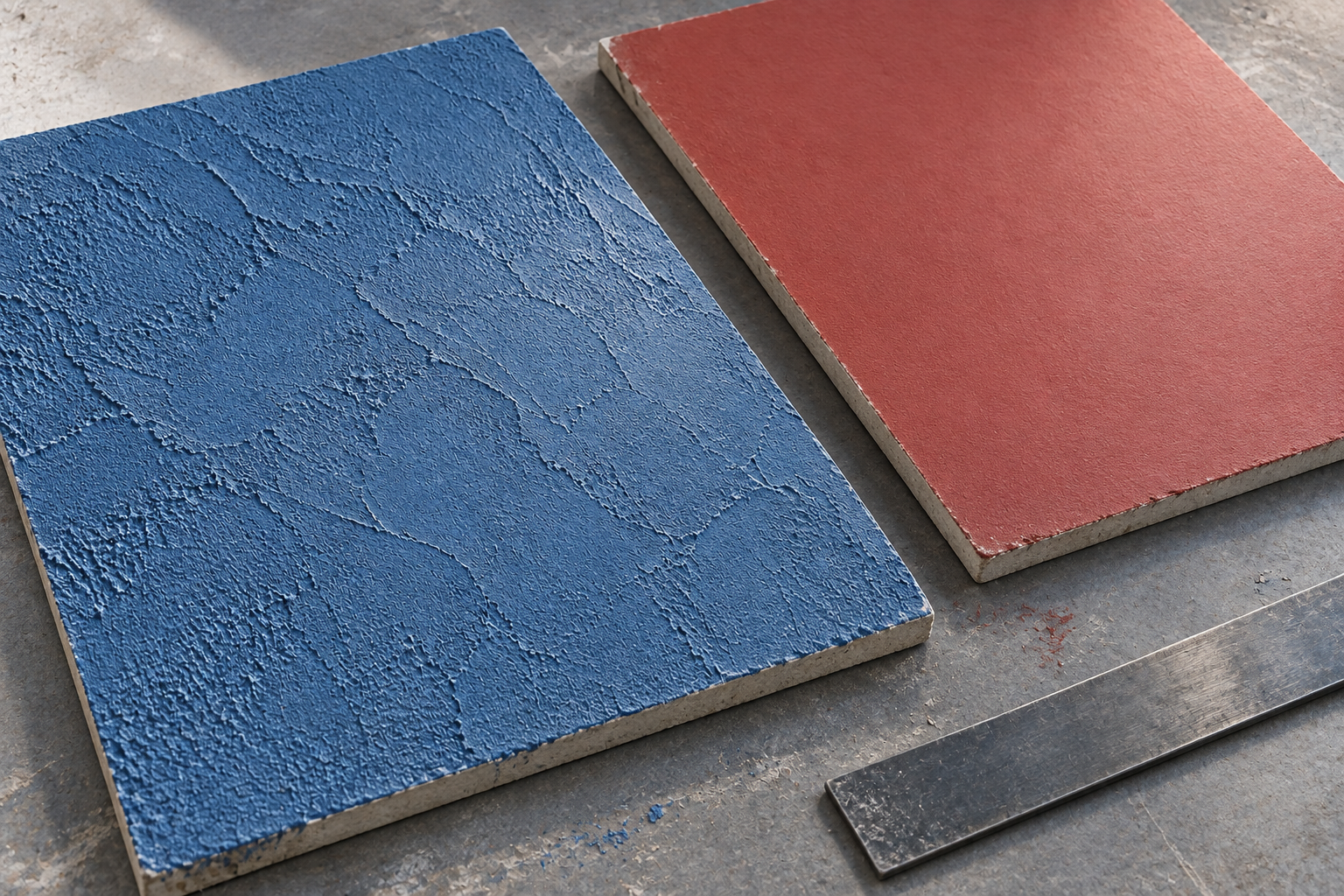
State exactly what the report must support
Start with the receiving surface and service conditions: an interior plaster wall, a prepared cementitious panel and a metal demonstration plate are different reference cases. Record the intended cleaning and exposure, not just the requested colour. Identify the proposed category in the Product Center, then request the actual product and system references.
Write each requirement as a decision: “Is this system acceptable on our specified prepared substrate?” or “Does the proposed finish meet our agreed appearance range?” Keep these questions separate from price and pack allocation in the complete coating quotation guide. A report can support one requirement while leaving another unresolved.
Match adhesion, gloss and durability to different evidence
The public scope of ASTM D3359 concerns tape-test ratings for relatively ductile coatings on metallic substrates. It identifies limits involving thickness and substrate, and notes that a multicoat failure can occur between layers. Do not assume that a tape rating transfers directly to a textured mineral wall finish. Ask the testing party to confirm the method’s suitability for the proposed system; a rating is not an absolute bond-strength value.
| Buyer requirement | Report details to compare | What would leave the decision open? |
|---|---|---|
| Adhesion to the specified surface | Substrate, preparation, full layer sequence, thickness, conditioning, method and failure location | A different substrate, omitted primer or unidentified layer failure |
| Agreed gloss appearance | Method, measurement geometry, specimen identity, readings and agreed acceptance range | A bare number without angle or a different specimen preparation |
| Resistance to repeated cleaning wear | Applicable method, coating system, conditioning, scrub conditions and endpoint | An unspecified “washable” statement or a result for another topcoat |
ASTM D523 describes specular-gloss measurement using 20°, 60° and 85° geometries. Treat the geometry as part of the result; numbers without it are incomplete for comparison. Its discussion also distinguishes other appearance aspects, including texture. Keep the approved physical finish reference alongside the report rather than reducing appearance approval to one number.
ASTM D2486 addresses relative resistance of wall paints to erosion from repeated scrubbing. That is a defined wear question, not a complete description of service life. For a textured decorative system, have the testing party establish whether the selected method and specimen represent the intended use. This guide does not prescribe a test procedure or a universal pass threshold.
Decide whether two gloss numbers are comparable
Consider a hypothetical report check: the agreed reference is recorded as 12 gloss units (GU) at 60°, while a supplier sheet shows 12 GU at 85°. Equal numbers do not establish an equal result when the geometry differs. Do not subtract them or invent a conversion factor to approve the order. The numbers here illustrate a document mismatch; they are not Montelise measurements or a recommended tolerance.
| Evidence received | Comparison decision | Next record needed |
|---|---|---|
| Reference: 12 GU at 60° | Identifies a result and angle, not a complete acceptance specification | Reference specimen, full system and agreed acceptance range |
| Supplier: 12 GU at 85° | Not directly comparable to the stated 60° reference | Results under the agreed applicable method and geometry |
| Supplier: 12 GU, angle omitted | Comparison remains unresolved | Corrected report identifying geometry and specimen |
BYK-Gardner’s gloss measurement explanation describes how measurement angle affects results and why conventional gloss readings do not fully capture complex structured-surface appearance. This supports checking the measurement conditions, not assigning a universal numerical limit to decorative plaster. Have the testing party confirm whether the chosen method represents the ordered finish.
For the review ledger, pair each value with its report and specimen ID, geometry, method edition, instrument identification and conditioning record. Compare the substrate and complete layer sequence too. Where surface direction or measurement position matters, ask the testing party to document the agreed sampling approach. A change from a rough panel to a smoother specimen must not disappear into a single averaged number.
Keep the affected gloss requirement open until the reviewer records a comparable result against the agreed criterion, or an explicitly approved change to that criterion. Preserve both the original and corrected reports. A matching gloss result would resolve only that requirement; it would not establish adhesion, scrub resistance or approval of the whole order. Send both reports and the unresolved fields with the quotation request so the supplier can propose the required evidence.
Lock the sample identity before comparing results
Request a traceable chain from the quoted product to the tested specimen: product or formula revision, batch or sample ID, substrate, preparation, each coating layer and any protective finish. Include application thickness and the curing or conditioning record. Where a field is missing, mark it unresolved rather than filling it from a different product’s technical sheet.
Record the method and edition, test date, issuer, result, acceptance criterion and any reported departures from the agreed method. The buyer and testing party should decide whether a departure affects acceptance. Use the drying and service-release guide to distinguish a sample ready to handle from one ready for the specified evaluation; no fixed curing time applies to every coating.
Triage an incomplete report without inventing a pass
Consider this hypothetical purchase review, not a Montelise test result. A buyer specifies a primed cementitious wall with a decorative finish and a protective coat. The supplier sends an adhesion rating from a metal panel, a gloss number with no geometry, and a scrub report for the same finish without the protective coat.
The buyer cannot yet accept the complete proposed system on that evidence. Put the adhesion item on hold pending method and substrate applicability review; request the missing gloss geometry; ask whether the scrub specimen represents the ordered layer sequence. None of these gaps proves that the product fails. They mean that the supplied evidence does not yet answer the purchase question.
Keep a short decision log with one row per requirement: evidence received, mismatch or missing field, responsible reviewer and next action. Release an item only when its agreed conditions are resolved. If the formula, preparation or protective layer changes, review which evidence remains applicable before carrying forward the earlier approval.
Send one coordinated technical and commercial brief
For a sample or bulk quotation, send:
- The substrate, preparation, intended location, exposure and cleaning expectations.
- The proposed layer sequence and identified finish reference.
- Required properties, proposed methods and acceptance criteria, with unresolved items clearly marked.
- Available report IDs, sample or formula revisions, and the specific gaps to resolve.
- Quantity by finish, pack requirements, destination and target decision date.
Use the OEM service for branding and packaging scope while retaining the same technical references. Ask the supplier to distinguish available evidence, additional evaluation needed and commercial conditions. This keeps the next reply focused on an approvable system and a usable quote.