Use texture wall coating samples to narrow colour and texture, then decide whether you need a project mock-up before approving the applied finish. A small board can help select a direction; it cannot automatically establish how a large wall, joints or the intended application technique will look. Record the substrate, coating system, lighting and approval scope with the sample, so a colour selection is not mistaken for permission to start the whole project.
For a distributor, the immediate decision may be which finishes to shortlist. For a project buyer, it may be whether the intended applicator can reproduce the selected appearance. These decisions need different evidence. Confirm available sample formats and product-specific application requirements before ordering them.
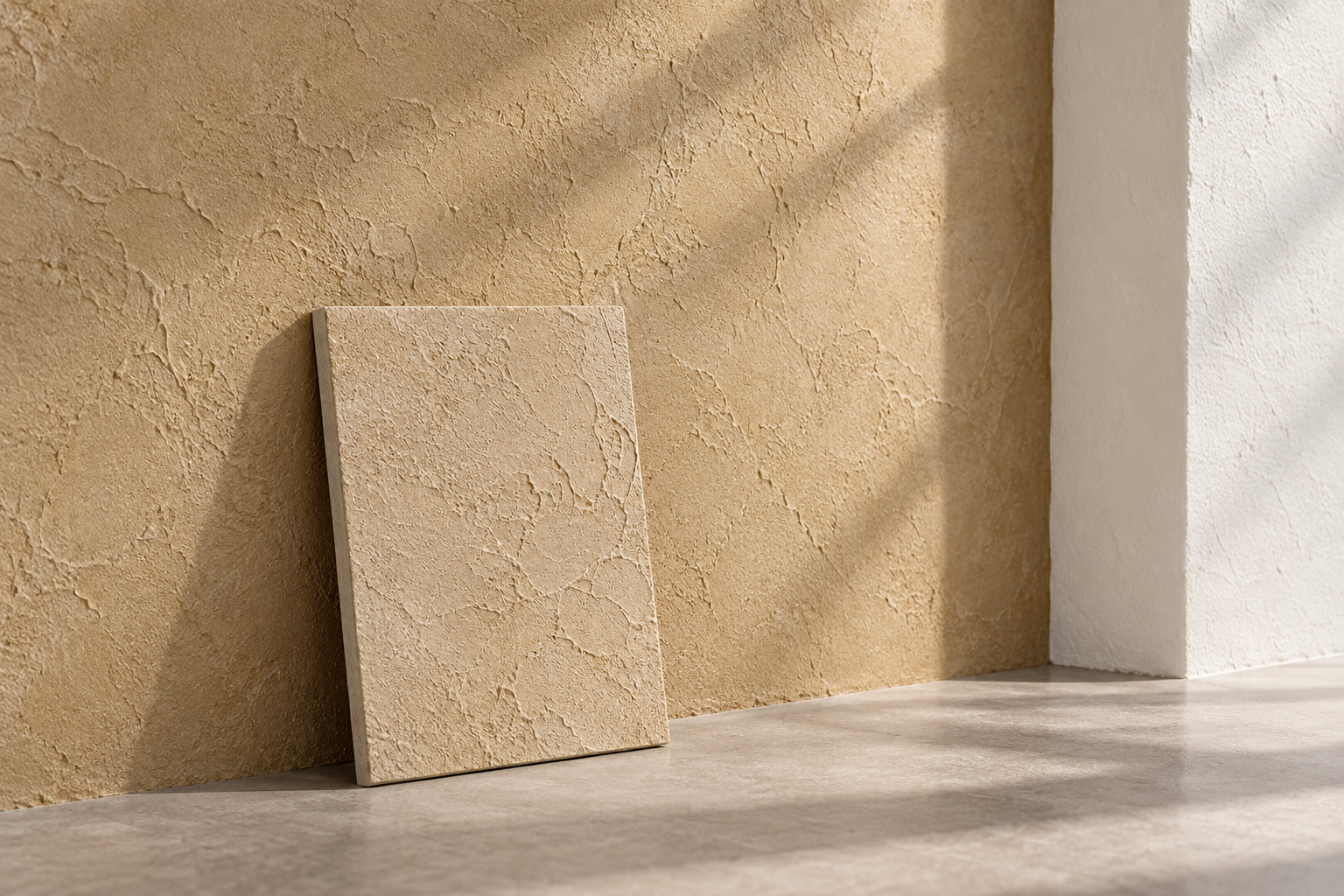
Decide what each sample can authorise
Name the decision on the sample request. This is a proposed procurement workflow, not a statement of Montelise sample services or a universal construction specification.
| Stage | Evidence to request | Decision to record | Still unresolved |
|---|---|---|---|
| Visual shortlist | Identified physical sample | Keep or reject colour and texture direction | Full wall appearance and application method |
| Applied finish review | Agreed mock-up using the intended substrate and system | Accept the defined appearance reference | Technical tests or commercial terms outside the review |
| Order release | Approved reference, closed actions and quote specification | Authorise the stated order scope | Later changes requiring fresh review |
Agree a panel extent that shows the features being assessed, including relevant edges, joints or texture scale. Do not prescribe one board dimension for every finish. The decorative coating manufacturer guide addresses supplier selection; this page addresses the scope of sample approval.
Fix the coating system before comparing boards
Assign a sample identifier and revision. Record the intended substrate, preparation, primer, finish and any sealer or topcoat references. Identify changes to those inputs rather than reusing the same sample name without explanation.
Record the tool and application technique. As a product-specific example, Dryvit’s Reflectit instructions use a mock-up under actual project conditions with the tools and materials intended for the work. Its dimensions and application settings are not Montelise specifications.
Set the review date using the selected system’s technical guidance. Appearance alone does not establish readiness for the next operation. The decorative coating drying-time guide separates recoating and service-release milestones.
Agree lighting and viewing positions before sign-off
Review the physical sample in lighting relevant to its intended use. Sto’s colour guidance explains that gloss, texture and lighting affect perceived colour and recommends physical samples and jobsite mock-ups for final approval. This is manufacturer background, not a Montelise performance guarantee.
Record daylight or the installed light setting, viewing positions and sample orientation. Compare revisions under the same agreed conditions. Photographs can record comments and location, but screen images should not replace the agreed physical reference.
If reviewers disagree about the appearance, use this comparison sequence before requesting a new batch or changing the finish:
- Return to the same identified sample and agreed viewing position. Record the light source and direction; do not compare a board held flat with a wall viewed upright as though the conditions were identical.
- Keep the sample fixed while reviewing the relevant light settings. Note where the objection appears: overall colour, local texture, a joint or an application boundary. Treat these as observations, not proof of a manufacturing defect.
- Compare the proposed revision with the retained reference under the same agreed conditions. If the substrate, product or application changed, record that change separately and decide which approval must be repeated.
This is a proposed review procedure, not a laboratory test or a universal acceptance standard. For reflective finishes, Dryvit’s product-specific instructions also discuss substrate imperfections and the difficulty of achieving the intended appearance over larger smooth areas under critical light. Confirm the corresponding limitations of the selected Montelise system rather than applying another manufacturer’s recipe.
If intended lighting is unavailable, record the remaining review instead of giving unconditional approval. Appearance acceptance does not replace separately required adhesion, durability or other performance evidence.
Write a conditional decision that can be resolved
Hypothetical example: a project team likes a board’s colour in daylight but has not reviewed it under the planned wall lighting. It records “colour direction accepted; project appearance approval on hold.” The next action is a mock-up review under that lighting with the intended applicator. This is a decision example, not a Montelise customer event or test result.
| Approval record | What to enter |
|---|---|
| Reference | Sample identifier, revision and retained reference location |
| System | Substrate, preparation and coating product references |
| Application | Tool, technique and relevant mock-up features |
| Review | Lighting, viewing positions, orientation and date |
| Scope | The specific decision accepted, rejected or on hold |
| Open action | Unresolved observation, responsible person and next evidence |
| Sign-off | Reviewer, date and conditions |
Agree acceptable variation with the project parties; do not invent a universal texture or colour tolerance. If the system or application method changes, identify which earlier approvals need review.
Reopen only the approval affected by a change
A signed board identifies a reference and its review conditions; it is not approval for every later substitution. Before releasing the affected quantity or starting the changed work, enter the changed input, affected area, previous reference and decision owner in a change record. Keep the old reference until the replacement decision is documented.
Lighting deserves a specific check. X-Rite explains metamerism: two samples may match under one light and differ under another. A changed lamp therefore calls for a fresh comparison; a photograph alone cannot establish whether the physical pair still matches. This does not diagnose every visible difference as metamerism.
Use the following as a proposed procurement workflow, not a universal test standard or a statement of Montelise approval services.
| Changed input | Evidence to compare | Decision still required |
|---|---|---|
| Planned light fitting or setting | Retained reference and proposed finish together under the revised project lighting | Reconfirm appearance for the affected location |
| Substrate or primer | Identified sample of the revised system plus its technical instructions | Recheck appearance and separately resolve compatibility or performance requirements |
| Finish or protective topcoat | New system sample compared with the retained reference | Decide whether colour, texture and sheen remain acceptable; record a new revision |
| Application tool or technique | Mock-up made with the proposed method and relevant wall features | Confirm the reproduced appearance before applying that method across the affected work |
Hypothetical change: the colour reference was signed under the planned lighting, but the project substitutes a different wall light before ordering. Retain the original sample ID and record the new fitting/setting. Hold appearance release for the affected wall, arrange the side-by-side physical review, and name who will accept or reject it. If accepted, append the revised lighting condition and date; if rejected, request an identified alternative and repeat that comparison. Neither outcome by itself approves a different primer, topcoat or technical performance requirement.
State which earlier decisions remain valid and which are superseded. Keep the affected quantity, review deadline and written decision together so a pending appearance check does not become an ambiguous instruction to release the entire order.
Carry the approved reference into the quote
Attach the approval record to the RFQ. Separate trial-application material from the proposed bulk order. Treat requested pack sizes as requests until availability, minimum quantities and the quotation basis are confirmed.
Use Product Center to identify the materials category. Include branded packaging in the OEM brief alongside the finish reference.
Send these inputs for a sample route or quote:
- Intended use, substrate and destination market.
- Finish reference, sample revision, current approval scope and any changed input awaiting review.
- System/application notes, review conditions and open actions.
- Next stage: shortlist samples, mock-up material or a defined bulk order.
- Quantity per finish and requested packaging or label scope.
- Target review date, approver and retained-reference arrangement.
Montelise must confirm product suitability, sample formats, technical requirements, packaging availability and commercial terms. Send the record through Contact so the inquiry identifies the decision still to be made.