Decorative coating drying time should be specified for the next activity, not treated as one deadline for the whole project. Ask the supplier separately when a coat can be recoated, when any protective finish can be applied, and when the completed surface can be cleaned or put into its intended service. A surface that feels dry does not establish all of those permissions.
Before ordering, request the current technical sheets for the complete system and connect each waiting period to its stated conditions. Share the substrate, application method, expected site temperature and humidity, and proposed handover date. The useful purchasing output is an agreed schedule with release conditions and a decision owner, rather than an unsupported promise that every decorative finish will be ready overnight.
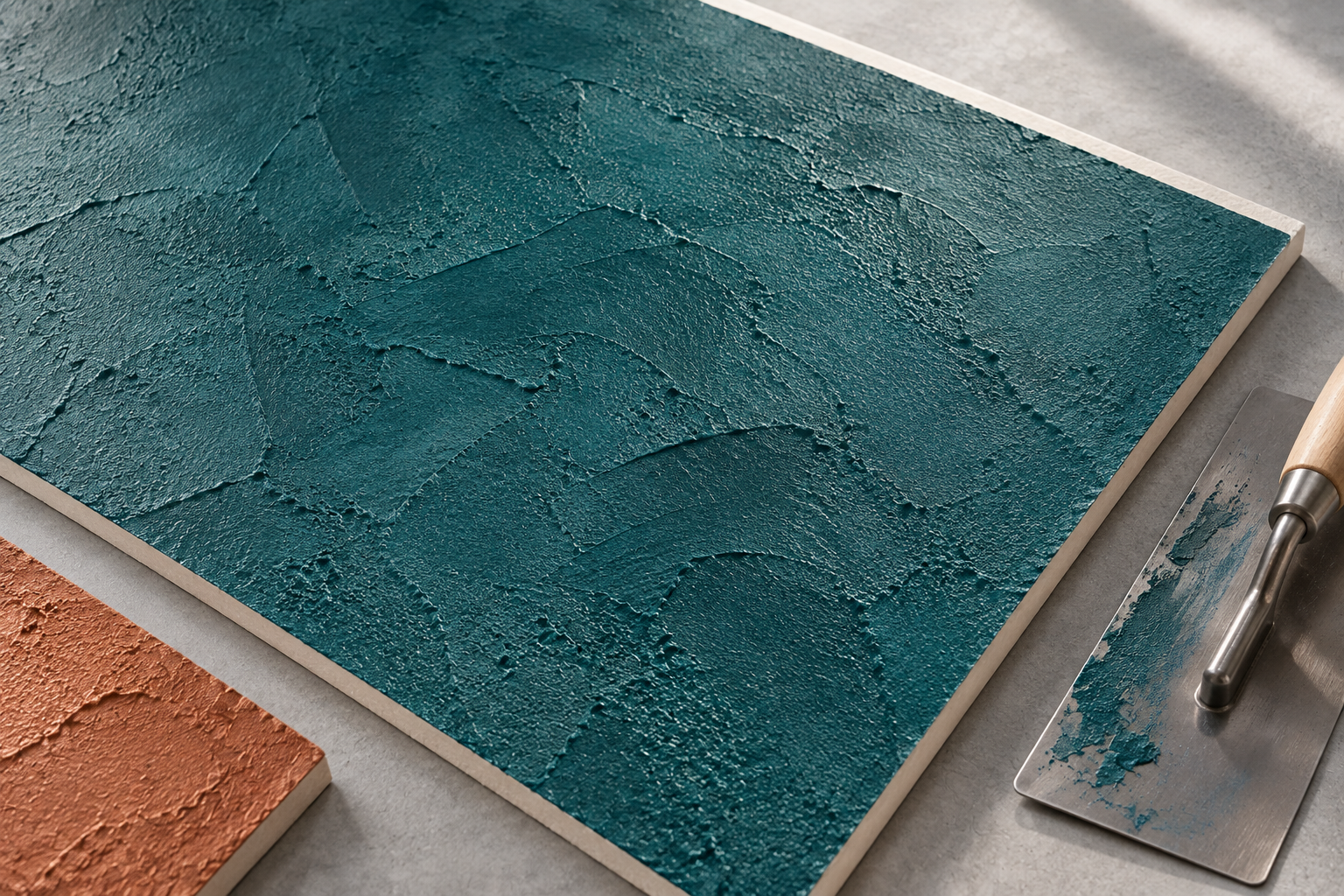
Which drying milestone does the supplier mean?
Separate touch dryness, readiness for the next layer and readiness for the intended use. Sherwin-Williams distinguishes surface drying from the time needed to reach optimum performance in its drying and curing guidance. Its general paint timings should not be copied into a specification for an unidentified decorative system.
Ask the supplier to name the milestone whenever a quotation says “fast drying.” Does it refer to a particular coat under reference conditions, or to completion of the full finish? Request the associated document and revision. If a timing has no defined starting point or permitted next action, it cannot reliably support the installation programme.
For multi-component materials, also request the usable time after mixing. That answers how long the applicator can use the prepared material; it is a different question from when the applied layer can receive another coat.
Compare decorative coating drying time across the full system
Start with the selected material in the Product Center and list every specified layer. Include the primer, decorative coats and protective finish where required. Use the decorative wall coating primer guide to record the preparation system alongside the finish.
Some decorative products form only one part of a system. For example, Novacolor’s Wall2Floor Top Coat technical sheet specifies a final protective layer from its named range. That requirement belongs to Wall2Floor; it illustrates why buyers must obtain their selected system’s complete instructions rather than assume the decorative layer is the final operation.
Use the following as a proposed purchasing worksheet. It contains no tested durations or Montelise performance commitments.
| Next activity | Written information to request | Release record |
|---|---|---|
| Apply the first decorative coat | Primer identity, substrate requirements and readiness criteria | Preparation accepted by the named responsible person |
| Apply another decorative coat | Minimum interval, any maximum interval, reference conditions and preparation if exceeded | Previous coat completion time and actual conditions |
| Apply a protective finish | Approved product, compatible layer sequence and waiting conditions | Correct system and next-layer approval |
| Clean or expose the completed wall to use | Cure or service-release requirements and allowed cleaning method | Written release for the particular activity |
Sherwin-Williams’ project checklist directs users to the product label for recoat times. For procurement, request clarification if the label and technical sheet appear to disagree. Do not resolve an uncertain interval by selecting the shorter one.
Record conditions before turning intervals into dates
Give the supplier the expected environment and ask which conditions must be maintained during application and drying. Record actual conditions at the work area, not only an outdoor weather forecast. Ask which measurements are needed, how they should be taken and who reviews a deviation.
Novacolor’s Wall2Floor sheet warns that low temperatures can delay or inhibit drying and hardening and advises against direct heat sources. Use that as a reason to obtain the selected product’s own limits and conditioning instructions; it is not a universal temperature specification for Montelise finishes.
The site record should identify the wall area, substrate preparation, product and batch, layer, application completion time and relevant environmental readings. Include the specified application thickness or consumption basis and actual method. If a coat or site condition differs from the agreed specification, refer the affected area to the supplier before releasing the next operation.
Build the programme from these verified intervals plus application work, inspection and access requirements. Do not merely add the shortest advertised drying times together. A delay on one layer may also affect the applicator’s return visit or the availability of the area for other trades; name the person who updates the programme.
Test the proposed programme with a worked example
The following is a hypothetical scheduling exercise, not a Montelise drying specification or a Novacolor application instruction. Assume a project-specific written instruction requires at least 12 hours between two decorative coats under maintained, approved conditions. Also assume each coat takes two hours, working hours are 08:00–17:00, and inspection is available before work starts.
| Planning step | Hypothetical result | Decision for the buyer |
|---|---|---|
| First coat applied Monday 08:00–10:00 | Waiting period starts at completion, Monday 10:00 | Record completion for the defined work area |
| Add the assumed 12-hour minimum | Earliest calculated point is Monday 22:00 | An elapsed interval does not create an available work shift |
| Next staffed slot is Tuesday 08:00 | Actual interval is 22 hours | Proceed only if conditions, readiness and any maximum interval permit |
| Second coat applied Tuesday 08:00–10:00 | New layer completion is Tuesday 10:00 | Protection, cleaning and service each need their own release |
The second coat therefore finishes 26 hours after the first coat began, rather than after the quoted 12-hour wait. This arithmetic still excludes any protective layers and service-release period. If an inspection or condition check fails on Tuesday, mark that operation on hold and revise the affected dates; do not assume that extra elapsed time has resolved the issue.
Compare offers using this same activity sequence. A shorter recoat interval may not advance the next staffed slot, while a different protective-layer requirement may change the total programme. Choose against the complete approved schedule and intended finish, not the smallest number in the quotation.
What if the next staffed slot misses the recoat window?
Add a latest permitted start only when the selected system’s supplier provides one. A minimum wait answers when the next operation may begin; it does not establish an unlimited window. Ask which layer pair the limit covers, which conditions apply and what review or preparation is required after a missed window. Do not infer a maximum from an unrelated coating or choose a preparation method without approval.
Additional hypothetical assumption: keep the example above, but suppose its project instruction also sets a 24-hour maximum before further review is required. This is a scheduling assumption, not a Montelise product limit.
| Available start | Elapsed since Monday 10:00 | Planning decision |
|---|---|---|
| Tuesday 08:00 | 22 hours | Inside the assumed 12–24-hour window; readiness and conditions still need approval |
| Tuesday 14:00 | 28 hours | Outside the assumed window; hold the next coat and request the specified recovery decision |
| Wednesday 08:00 | 46 hours | A later shift does not restore the missed window; revise the programme after written instructions |
In this example, the latest assumed point is Tuesday 10:00, leaving only two hours between the proposed 08:00 start and that point. Confirm whether the actual instruction governs the start or completion of application; do not silently use the more convenient interpretation. Record the affected wall area, previous-layer completion, actual conditions, next available crew slot and decision owner. Ask the supplier to identify any permitted preparation and subsequent waiting period before booking the return visit. Extra drying time alone is not a recovery instruction.
Release cleaning and handover as separate decisions
Confirm what “handover” includes: visual inspection, access for other trades, normal use or cleaning. Ask whether temporary protection is permitted and obtain the product-specific method before covering or taping a finished surface. Acceptance of appearance does not by itself authorise every later activity.
Sherwin-Williams’ scrubbability guidance identifies inadequate curing before washing or scrubbing as a potential problem. For a decorative finish, request the approved cleaning method and earliest permitted cleaning stage. This does not establish a washability rating or a universal cure period.
Keep the selected technical sheets, application records and written release with the project handover pack. State any activity still restricted and who can remove that restriction. If the planned opening date is incompatible with the confirmed system schedule, resolve the material selection or programme before committing the order.
Send a schedule-focused RFQ
For OEM or private-label requirements, ask how the confirmed application instructions will be reflected in the supplied documentation. Avoid printing a drying claim on artwork before the supplier has approved its scope and conditions.
- Product and complete layer sequence, including any protective finish.
- Substrate, wall area, preparation and intended application method.
- Expected site conditions and any restrictions on ventilation or access.
- Planned application dates, next-trade access, first cleaning and intended use.
- Requested technical-sheet revisions, minimum/maximum recoat intervals where specified, and the decision route for a missed window.
- Person responsible for recording conditions and approving the next operation.
- Quantity, pack format, destination and requested delivery schedule, subject to confirmation.
Use the decorative coating manufacturer guide for the wider supplier review. Send Montelise the proposed system and project dates to discuss decorative coating drying time alongside the order. Product suitability, intervals, release criteria and delivery terms require confirmation for the actual specification.