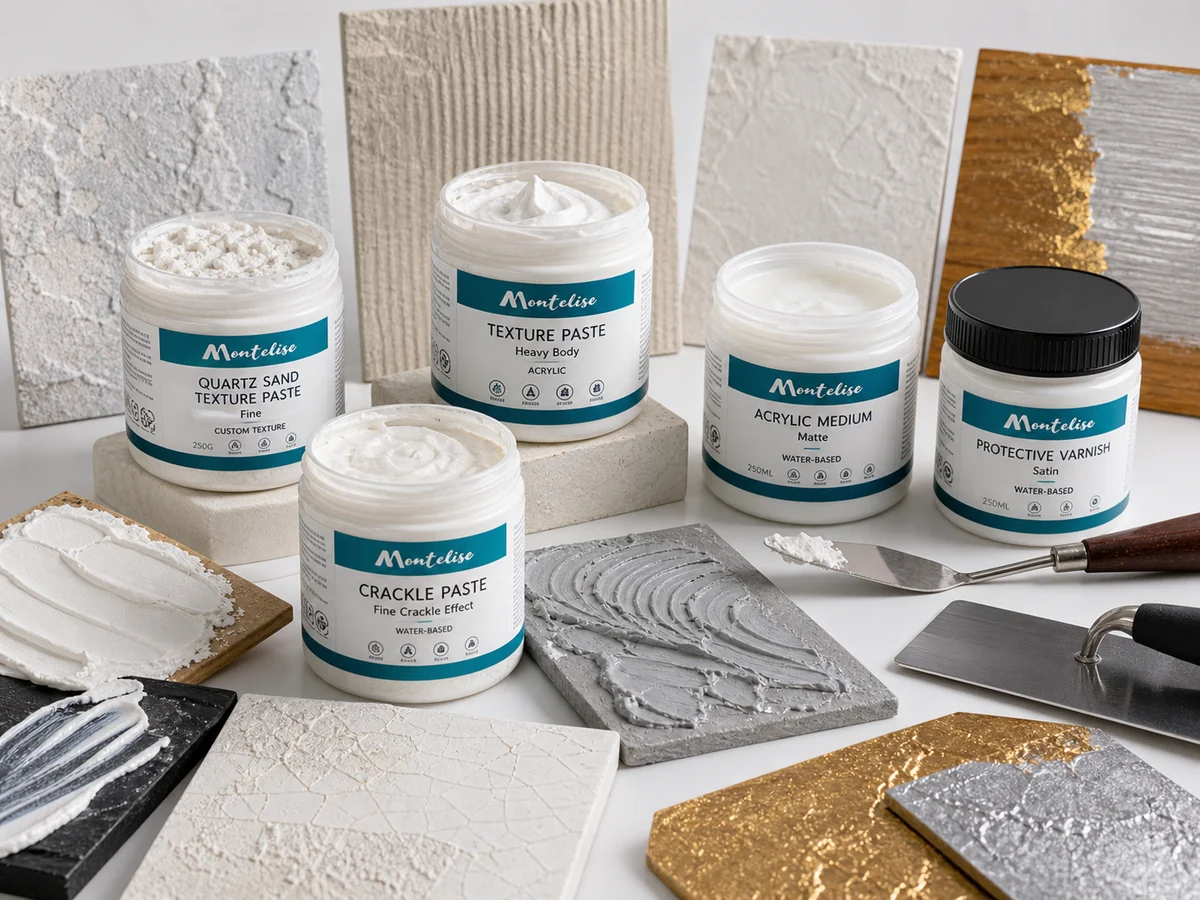
Texture paste MOQ is rarely a single number that a buyer can compare across suppliers. A 250 ml art jar, a 1 kg wall-finish tub, and a custom-labeled heavy-body paste may use the same product family but not the same filling, packaging, print, or carton logic. Buyers get a more usable quotation when they describe the first launch route rather than asking only for a headline minimum.
For art retailers, decorative-coating distributors, and private-label teams, the practical decision is how to keep the first order narrow enough to approve while leaving a clear route for repeat supply. Start with one paste body, one or two pack sizes, and the surface on which the material will actually be judged. Then add labels, carton requirements, and extra finishes after the approval path is stable.
Buyer quick links
- Explore texture paste, mediums, paint, coating, textile, and transfer product lines: Product Center
- Compare private-label packaging and custom-development routes: OEM&ODM
- Send your pack plan and quantity split: Contact / Get Quote
- Start with the broader product-sourcing page: Texture Paste Supplier
Separate the MOQ Into Four Commercial Decisions
A supplier can only quote texture paste MOQ clearly when the buyer distinguishes four decisions that often get blended together.
| Decision | What the buyer should define | Why it changes the MOQ discussion |
|---|---|---|
| Paste base | fine, heavy body, quartz sand, crackle, or special effect | Each body needs its own formula and batch plan |
| Pack family | 250 ml jar, 500 ml jar, 1 kg tub, 5 kg pail | Filling and container availability do not always align |
| SKU mix | one neutral paste or several finishes and label versions | More variants can split the practical run |
| Print route | temporary sample label, sticker, wrap label, or carton | Custom print materials often have their own threshold |
For example, a single 500 ml heavy-body SKU in a standard export carton is a simpler first-order conversation than six finishes in 250 ml and 1 kg formats with multilingual labels. It does not mean the wider range is impossible; it means the quote should show which part of the minimum belongs to paste production and which part belongs to packaging or artwork.
Buyers comparing texture and application options first can review Modeling Paste Manufacturer before fixing the pack route.
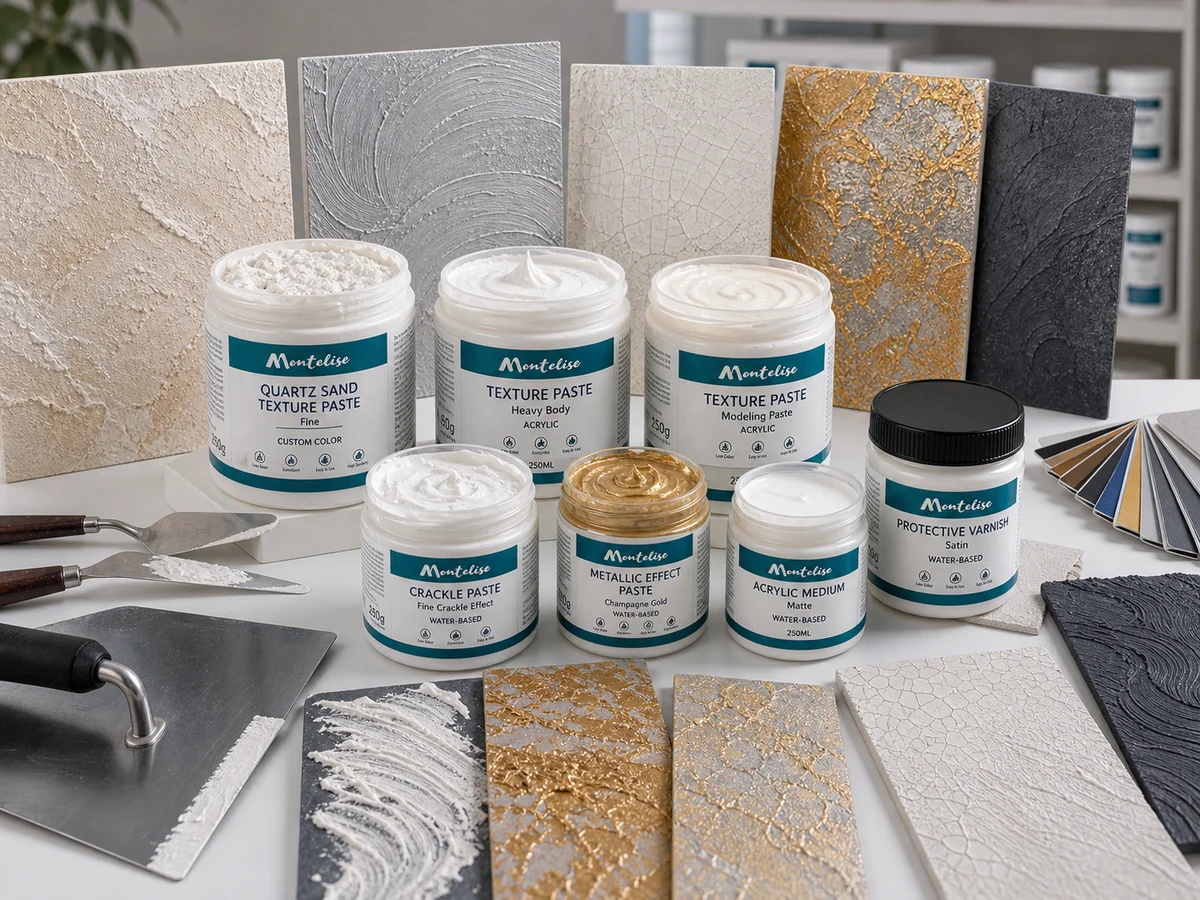
Choose a First Pack Route That Matches the Sales Channel
The right texture paste minimum order quantity depends on where the buyer will sell or use the material. Packaging should follow that route instead of forcing every project into the same jar size.
| Buyer route | Useful first pack direction | Approval point to lock before bulk production |
|---|---|---|
| Art and craft retail | 250 ml or 500 ml jars | body, lid, label panel, carton count |
| Workshop or studio refill | 1 kg tubs | fill weight, opening diameter, reseal handling |
| Decorative sample program | 1 kg test tubs or 5 kg pails | panel size, texture depth, finish reference |
| Distributor assortment | one lead retail jar plus one bulk format | which SKU owns the first production slot |
Do not assume that a mixed 250 ml / 500 ml / 1 kg launch will carry one universal MOQ. Ask the supplier to identify the lead pack family and show which secondary pack can follow after the first sample approval. For deeper pack comparison, see Texture Paste Distributor Pack Sizes.
Planning a texture paste first order?
Share the paste type, target surface, planned jar or tub size, number of SKUs, artwork status, and destination market with Montelise. The team can suggest a sample route and clarify which parts of the MOQ are formula, packaging, or print related.
Approve Texture on the Surface That Will Sell It
MOQ planning should not outrun product approval. A heavy-body paste that looks right on a primed canvas can behave differently on MDF, a rough wall board, or a decorative sample panel. Asking for a broad pack mix before that review creates expensive revisions later.
A stronger sample brief includes at least these details:
- the target substrate: primed canvas, MDF, gypsum board, cement panel, or another real surface
- the application method: palette knife, trowel, stencil, roller, or brush
- the texture requirement: smooth, grainy, high-build, crackle, metallic, or quartz-sand effect
- the sample format: a filled evaluation jar, a knife-applied panel, or both
- the review timing: first application plus dry-down observations after 24 to 48 hours
- the retained approval reference: a sample code, panel photo, and signed comments for repeat orders
This prevents a common sourcing mistake: approving a product from a wet jar photo, then discovering that shrinkage, edge hold, crack behavior, or texture depth reads differently on the finished surface. Buyers needing a private-label route can connect that sample work to Private Label Modeling Paste.
Keep Artwork and Cartons Out of the First Formula Decision
Custom packaging is important, but it does not need to be the first bottleneck. In many first orders, the paste body and container family can be approved with stock jars or simplified sample labels. Full artwork is then released once the buyer is ready to book production.
Before print release, confirm:
- final container and fill weight, such as 250 ml, 500 ml, 1 kg, or 5 kg
- editable label artwork in AI or print-ready PDF
- barcode owner and whether each SKU needs a unique UPC, EAN, or internal code
- language versions and any market-specific label wording the buyer must supply
- master-carton count, outer-carton marks, and mixed-SKU carton rules
- neutral export carton versus branded shelf carton
- destination documents required with shipment, such as commercial invoice, packing list, SDS, COA, or certificate of origin when applicable
These are procurement details, not decoration. A buyer can have a finished texture formula and still miss a production window because barcode assignments, carton marks, or final artwork arrived after the packaging slot was planned.
Ask for Lead Time by Dependency
The useful question is not “What is your lead time?” but “What must be approved before each part of the schedule can start?” For texture paste, the sequence usually depends on the paste sample, the chosen pack family, artwork release, carton confirmation, and production booking.
Request a schedule with separate checkpoints for sample preparation, buyer feedback, packaging or label approval, bulk production, and shipment readiness. If the order includes a grainy paste, a metallic medium, and a smooth modeling paste, ask whether they can share a shipment window or need separate production timing. This is more transparent than one broad delivery promise.
Freeze a Reorder Control File Before Shipment
The first PO should create a repeatable reference, not a new discussion every time. Keep one reorder file that includes:
- approved formula or sample code and the exact texture description
- surface and application method used for signoff
- dry-down notes, including shrinkage, crack, or edge-hold comments
- final pack size, jar or tub style, cap, fill weight, and carton count
- label artwork version, barcode file, and carton-mark layout
- retained sample photograph or physical panel reference
- any market-specific label or export-document variation
That file makes the next order easier to compare against the original result. It also protects the buyer when the same product moves from a 500 ml retail jar to a 1 kg workshop tub: the approved body stays identifiable even though the packaging route changes.
What to Send for a Faster Quote
What to send for a faster quote
- Paste type and intended application: art texture, decorative panel, workshop, or refill supply
- Target substrate and a photo, swatch, or sample panel if available
- Desired texture: smooth, heavy body, quartz sand, crackle, metallic, or another special effect
- First pack family and fill weight: 250 ml, 500 ml, 1 kg, 5 kg, or a planned alternative
- Estimated quantity per SKU and whether the first order mixes finishes or label versions
- Sample format and approval timing, including 24- to 48-hour dry-down review
- Artwork status, barcode requirements, carton marks, destination market, and target shipment month
FAQ
Is texture paste MOQ based on jars or kilograms?
It can be based on both. The formula batch, container family, fill weight, label print, and carton format may each influence the practical minimum. Ask for those components to be shown separately.
Can a buyer start with one texture paste SKU and add more later?
Usually that is the safer route. One approved paste body and pack family gives the buyer a clearer sample and reorder reference before expanding to more finishes or sizes.
Should custom labels be ready before the first sample request?
Not always. Many projects review the paste in stock or simplified sample packaging first, then release editable label artwork after the formula and container choice are approved.
Why should texture paste be tested on the actual substrate?
Surface absorption and application method can change the apparent texture, dry-down, crack pattern, and edge hold. The real application surface is a better approval reference than a wet jar photo.
Final Thought
Texture paste MOQ becomes manageable when buyers separate the paste base, pack family, SKU mix, and print route; approve the material on the right surface; and retain a full reorder reference before shipment. Montelise can help B2B buyers plan texture paste, modeling paste, and special-effect material samples around a realistic packaging and bulk-order path. contact Montelise with your product brief to request samples or a quote.