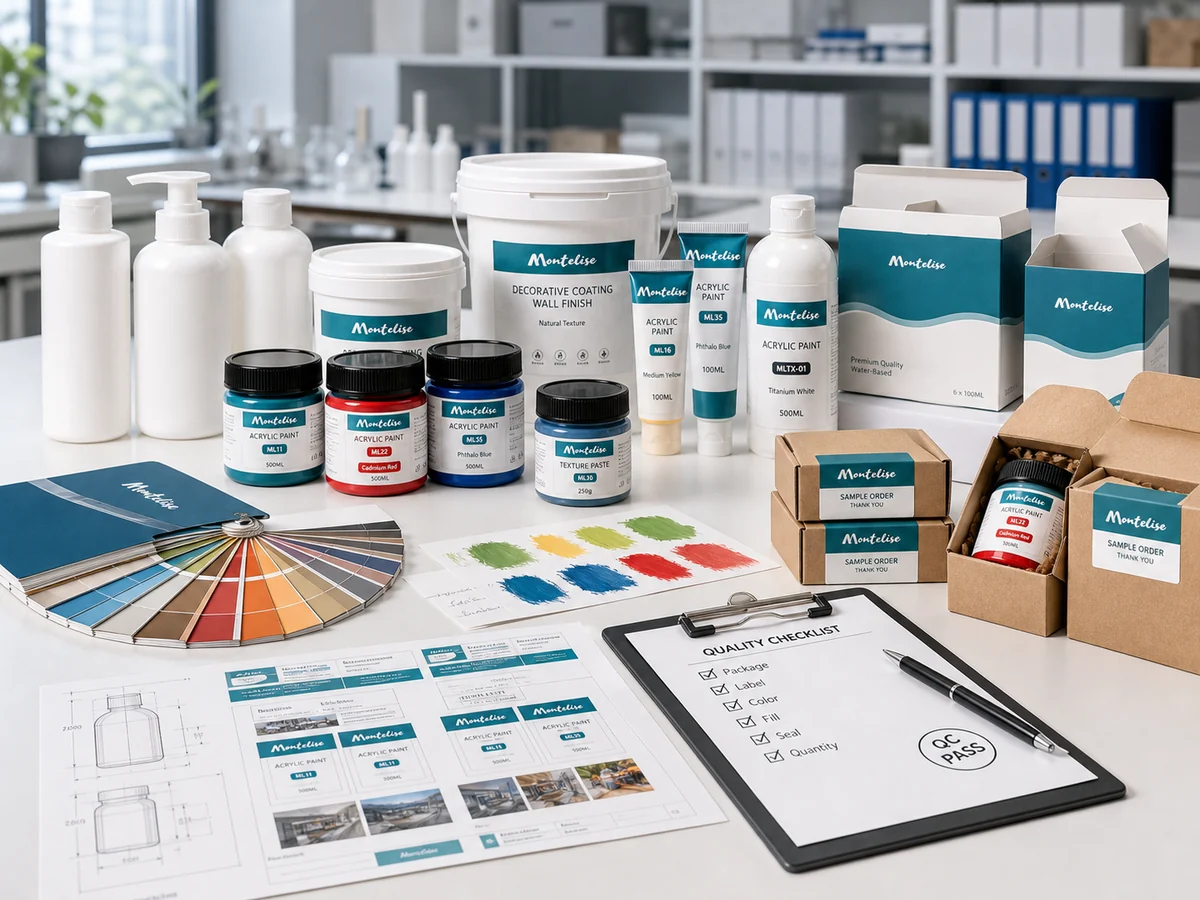
Private label acrylic paint projects usually slow down at the artwork stage, not the formula stage. Buyers may already like the colors, sample viscosity, and bottle shape, but the order still cannot move because the 250 ml bottle label was designed for a 100 ml jar, the barcode panel is too narrow, or the carton mark was never approved for the destination warehouse.
This page is for importers, art brands, school-supply buyers, craft retailers, and OEM sourcing teams that need a clean label approval process before bulk production. It supports the main Acrylic Paint Manufacturer page and focuses on the practical details that reduce artwork delays: pack size lock, label file setup, color naming, carton marks, and reorder control.
Buyer quick links
- View acrylic paint and color material product lines: Product Center
- Compare private label, custom color, and packaging options: OEM&ODM
- Review the main acrylic sourcing page: Acrylic Paint Manufacturer
- Send SKU count, pack sizes, and artwork status: Contact / Get Quote
Lock the Selling Pack Before the Designer Starts
The first artwork checkpoint is simple: confirm the actual selling pack. A private label acrylic paint range can use 60 ml tubes, 100 ml jars, 120 ml squeeze bottles, 250 ml bottles, 500 ml bottles, or 1 L packs, and each format changes the printable panel space.
If the pack changes after the label draft is finished, the buyer often has to redo:
- label dimensions and bleed lines
- barcode placement and quiet zone
- color-name layout
- net content wording
- carton quantity statement
Use one working table before artwork begins:
| SKU route | Common pack size | Label planning point | Typical risk if delayed |
|---|---|---|---|
| Retail starter set | 60 ml to 100 ml | Small front panel, tight barcode space | Text becomes unreadable after shrink or curve |
| Craft single SKU | 120 ml to 250 ml | More room for color name and warnings | Buyers approve copy but not final bottle circumference |
| Classroom or studio line | 500 ml | Larger label panel, stronger carton planning need | Carton count changes after label code assignment |
| Distributor refill pack | 1 L or 2 L | Product code and warehouse mark become critical | Reorders use different naming than first shipment |
For most first orders, it is better to freeze one bottle family first and expand later. That lowers artwork revision count and keeps MOQ discussions tied to real SKUs instead of placeholder packs.
Planning a private label acrylic paint order with custom labels?
Share your pack size, color count, label status, estimated quantity, and destination market with Montelise. The team can flag artwork risks, sample steps, and MOQ trade-offs before you lock the first production run.
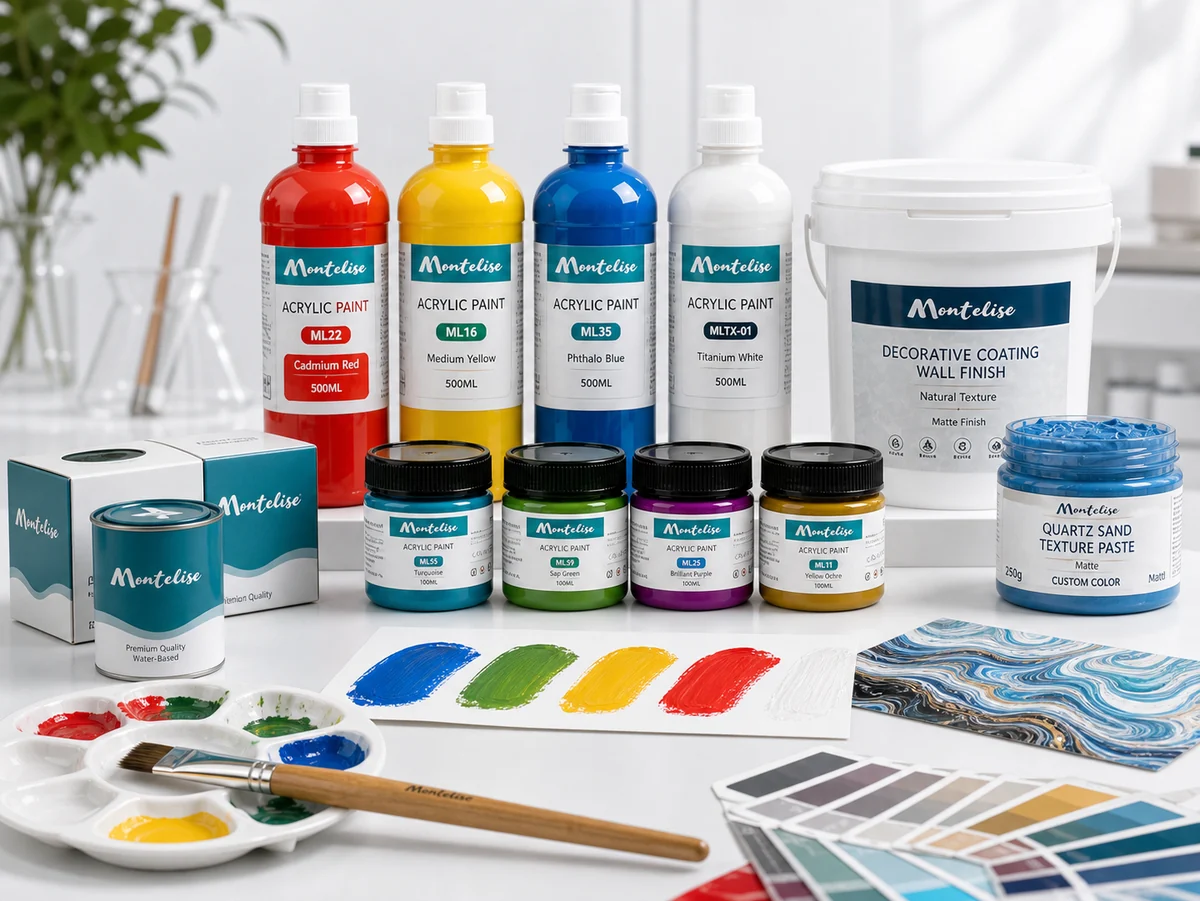
Prepare the File Set Buyers Usually Forget
Acrylic paint label work moves faster when the buyer sends a full file set instead of only a front logo. The missing files are usually what hold the order.
Before the factory prepares final print-ready files, buyers should confirm:
- editable artwork in AI, PDF, or high-resolution layered format
- logo color references in CMYK, Pantone, or approved print values
- barcode type such as UPC or EAN, plus the final number list
- legal or marketing copy that must appear on front and back panels
- language versions for each market
- net content style, for example
120 ml,250 ml, or500 ml - space needed for batch code or production date printing
If the buyer is still testing a new market, a temporary route can be simpler: approve the product sample first, keep the label layout limited to core fields, and delay more complex shelf claims until the second order. That approach often saves time when the first PO covers only 12 to 24 colors.
Build Color Naming That Works in Reorders
Private label acrylic paint artwork is not only a design issue. It is also a reorder control issue. A clean label should connect the marketing color name to an internal color code that the buyer and supplier can both reuse.
For example, a label might show Ocean Blue on the front panel, but the order file should also keep a stable internal reference such as AB-214 or the approved shade card number. Without that second reference, the reorder team may rely on memory, screenshots, or a revised logo file rather than the approved color sample.
Buyers should ask the supplier how these records are stored:
- approved drawdown or retained sample date
- final color name and internal code pair
- pack size tied to that color
- label version number
- carton quantity per SKU
- first bulk shipment date or PO reference
This matters even more when one project includes matte basics, gloss accents, metallic shades, or fluorescent colors in the same launch. The label family may look unified, but the production notes behind those shades should still stay separate.
Separate Label Proof Approval From Bulk Print Approval
Many delays happen because buyers approve a digital mockup and assume the label is ready for production. A better OEM process uses two approvals.
- Sample proof approval: confirm copy layout, color naming, logo position, pack size wording, and barcode area.
- Bulk print approval: confirm final dieline, print quantity, carton count, and the exact file version that will be used in production.
For acrylic paint private label projects, this split is useful because sample bottles may use short-run stickers while bulk orders may use a different print process. The buyer should not assume that a sample sticker on a 250 ml bottle automatically confirms the final roll-label output for 10,000 units.
Useful checks at the proof stage include:
- whether the curved bottle causes logo distortion
- whether white text sits on a dark acrylic paint color block
- whether multilingual copy still fits after translation
- whether the cap color and bottle color make the SKU easy to identify in a carton
- whether the batch code area stays clear after the label is wrapped
The Artwork Choices That Change MOQ and Lead Time
MOQ for private label acrylic paint is rarely driven by formula alone. Label complexity, color count, and carton structure often move the real starting quantity.
Lead time and MOQ usually change when the buyer adds:
- many low-volume shades in one launch
- separate label versions for different countries
- display boxes instead of plain master cartons
- custom printed cartons instead of stock outer boxes
- multiple bottle sizes in one first order
- late artwork changes after color samples are approved
An order for 12 colors in one 250 ml bottle may move much more smoothly than an order for 24 colors split across 120 ml, 250 ml, and 500 ml packs with three label languages. Buyers comparing suppliers should ask where the actual bottleneck sits: bottle supply, label printing, carton print, shade approval, or final artwork sign-off.
If the project also needs export paperwork, pair this step with the Acrylic Paint Export Documents Checklist so invoice wording, carton marks, and label names stay aligned.
What to Send Before Montelise Prices the Label Route
The fastest quotation does not start with “please quote private label acrylic paint.” It starts with a workable SKU brief.
Send these details first:
- product type and intended surface, such as canvas, paper, wood, or classroom craft use
- color count and whether the shades are standard, metallic, fluorescent, or custom matched
- target pack size per SKU, such as 120 ml, 250 ml, 500 ml, or 1 L
- whether the first order uses single SKUs, set boxes, or mixed displays
- artwork status: ready file, draft file, or factory assistance needed
- barcode list and destination market
- carton preference, such as plain export carton, printed carton, or retail display box
- target sample timing and target bulk shipment month
Buyers that are still confirming product performance should also review the OEM acrylic paint sampling checklist and the custom acrylic paint color matching guide before freezing final label files.
What to Send for a Faster Quote
What to send for a faster quote
- Product type and intended selling channel
- Color count and shade reference method
- Pack size per SKU
- Artwork format and barcode status
- Carton or display box preference
- Estimated quantity per color and per pack size
- Destination market and target launch timeline
FAQ
What file format should buyers prepare for private label acrylic paint artwork?
Editable AI or layered PDF files are usually safer than flattened screenshots because the factory may still need to adjust dielines, barcode position, batch-code space, and multilingual copy.
Can buyers use one label design across 120 ml, 250 ml, and 500 ml acrylic paint packs?
Usually not without adjustment. The circumference, panel height, barcode space, and readable copy area change across pack sizes, so each bottle family should be checked separately.
Why does label artwork affect acrylic paint MOQ?
MOQ can move when the order includes many shades, several label versions, custom cartons, or more than one bottle size. The artwork route changes print setup, carton planning, and production coordination.
What helps the supplier control reorders?
Keep a stable link between the approved color sample, internal color code, label version, pack size, and carton quantity. That record is more reliable than using only the marketing color name.
Final Thought
Private label acrylic paint labels work best when buyers freeze the pack size early, send complete artwork files, tie color names to real reorder codes, and separate proof approval from bulk print approval. That turns the label stage from a delay point into a controllable sourcing step.
Ready to review private label acrylic paint packaging, labels, or OEM order planning? contact Montelise with your SKU list, pack sizes, artwork status, quantity plan, and destination market to request samples or a practical bulk quote.