Plan decorative coating batch consistency before splitting a project into deliveries. Ask whether the supplier can reserve one production batch for each continuous wall area, and record the answer alongside the approved finish sample. If several batches are needed, agree their allocation, comparison procedure and release decision before application. A shared colour name is not enough to identify what was supplied.
For the purchase order, connect each delivery to its product reference, batch or tinting record, pack quantity and intended wall area. Also decide who holds material for repairs. This creates a traceable handover from supplier to receiver and applicator, without promising that different batches or later touch-ups will look identical.
Separate colour identity from batch identity
Record the coating product, base where relevant, colour reference, finish and approved physical sample code. Then ask how the supplier identifies the production lot and any subsequent tinting operation. A customer-facing colour code and a production batch number answer different questions; retain both when provided.
For OEM and private-label supply, request a traceable connection between the branded label and the supplier’s record. Ask which identifier appears on the pack and packing list. Do not invent an internal code that the supplier cannot map back to the delivered material.
Choose the intended material from the Product Center before making a batch request. A finish or base change should trigger a new review rather than being treated as another delivery of the same specification.
Allocate batches to wall areas before dispatch
Give the supplier and applicator a wall schedule showing continuous surfaces, delivery phases and possible stopping locations. Ask whether the proposed quantities can be supplied from one batch, whether stock can be reserved and how long that reservation lasts. These are commercial questions, not assumed Montelise stock commitments.
Novacolor’s Wall2Floor Top Coat sheet recommends completing a job with the same manufacturing batch. For an unavoidable change, it identifies breaks in surface continuity as joining locations. This is guidance for that system, not approval to change any decorative finish at any corner.
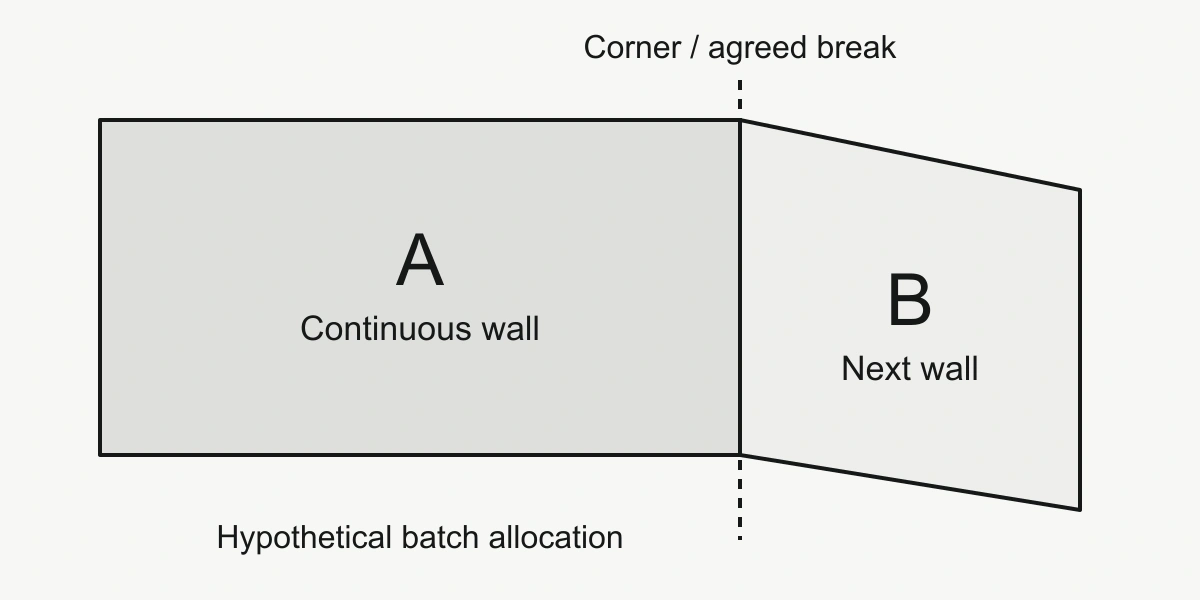
Use the schematic as a planning question: can one agreed lot complete the first wall, with any later lot starting at a supplier-approved break? Ask the applicator to confirm the location and required quantity. Do not split a continuous feature wall merely to match a delivery date.
Check decorative coating batch consistency at receipt
Use a receipt-and-release record before packs reach the application area. The table below is a proposed purchasing control, not a test standard or a claim about Montelise’s current inspection process.
| Record | Evidence to request | Hold point |
|---|---|---|
| Product and finish | Product/base reference, colour, approved sample code | Identity differs from the order |
| Batch allocation | Pack identifiers and quantities by wall and delivery | Unplanned lot or missing identification |
| Sample comparison | Labelled trial area, actual system and assessment conditions | Difference needs supplier review |
| Release decision | Named approver, date and accepted scope | No written decision for the affected area |
| Repair reserve | Batch, sealed-pack quantity, custodian and storage instruction | Reserve or storage responsibility unresolved |
For a new lot, agree whether a comparison sample is needed before release. Keep substrate, preparation, tools and finish sequence consistent with the accepted reference. Use the primer selection guide to document preparation, and the texture sample review guide to organise the finish record.
Compare at the supplier-specified assessment stage under agreed lighting and viewing conditions. Sherwin-Williams explains that light and finish influence perceived colour. A phone photograph alone is therefore insufficient to define acceptance. If instrumental readings are requested, agree the method and limits for the actual finish; do not insert an arbitrary universal tolerance.
Resolve an unexpected lot before releasing a delivery
Suppose an order calls for 24 sealed packs from lot A for one continuous feature wall. The delivery contains 18 packs marked A and six marked B. These are hypothetical quantities and identifiers, not a Montelise order or a coverage estimate. The pack count is correct, but the agreed lot allocation is not. Do not release the six substitute packs merely because the colour name matches.
Record the discrepancy before moving material into the application area. Photograph the legible pack identifiers and relevant delivery-note entries, retain the original documents, and keep the affected packs identifiable. A purchasing hold means they are not yet approved for this wall; it is not a technical conclusion that the material is defective.
| Delivery line | Quantity received | Proposed control before application |
|---|---|---|
| Lot A, matching the planned lot | 18 packs | Confirm whether these packs can complete an independently agreed area; do not assume they cover the entire wall |
| Lot B, not in the wall allocation | 6 packs | Hold this allocation pending supplier and project decision; do not mix it into A without product-specific written instructions |
| Total delivery | 24 packs | Reconcile quantity separately from lot identity; a complete count is not acceptance of the substitution |
Ask the supplier to identify the substitution and propose an order-specific resolution: supply the remaining agreed lot if available, revise the wall allocation with the applicator, or arrange an agreed comparison before deciding. None of these routes guarantees a visual match or creates an automatic right to replacement. Confirm commercial responsibilities and any revised programme in writing.
The release record should name the purchase-order line, delivered lot, affected packs, wall area, decision owner and date. Link any comparison record and the supplier’s instructions; retain the original discrepancy instead of overwriting it. If application has already started, record exactly where each lot was used and obtain a project-specific remedial decision before continuing. Do not cover the boundary first and investigate later.
Confirm mixing instructions instead of assuming them
Some manufacturers give batch-remixing guidance: Novacolor’s Dune technical sheet is one example. Obtain the selected product’s written instructions before adopting that approach. Confirm which materials may be combined, at what stage, and how the combined material will remain traceable.
For a multi-component system, ask specifically how batch management relates to component ratios and usable time after mixing. Do not treat a general batch-consistency recommendation as permission to alter the formula, add water or combine different products. If the instructions are unclear, hold the affected allocation and ask the supplier to resolve it.
Reserve repair material without guaranteeing invisible repairs
Agree the repair reserve separately from application quantities. Record the product and batch, quantity, storage location and responsible person. Ask the supplier for the actual storage conditions, shelf life and any different limits once a pack has been opened; do not promise that retained material will remain usable indefinitely.
Sherwin-Williams’ touch-up guidance highlights original-batch material, colour, sheen and application tools. That does not establish an invisible repair for a textured or metallic decorative finish. Agree a small repair trial and the next action if its appearance is unacceptable.
Keep the wall allocation and application record with the reserve. When reordering, send the original references and explain whether the material is for a new wall or a repair to an existing one. Ask what comparison is required if the original batch is no longer available.
Include these inputs in a phased-delivery RFQ
- Product, base where applicable, finish, colour and approved sample reference.
- Wall schedule with continuous areas and proposed batch-change locations.
- Required quantities and dates by delivery phase, subject to confirmation.
- Production/tinting identification and packing-list requirements.
- Comparison procedure, decision owner and unresolved acceptance questions.
- Repair reserve, custodian and requested storage guidance.
- Pack format, private-label needs and delivery destination.
Use the decorative coating manufacturer guide for the wider supplier assessment. Send Montelise the wall schedule and sample references to discuss decorative coating batch consistency and a phased quotation. Batch availability, reservation, acceptance requirements and commercial terms need written confirmation for the selected order.