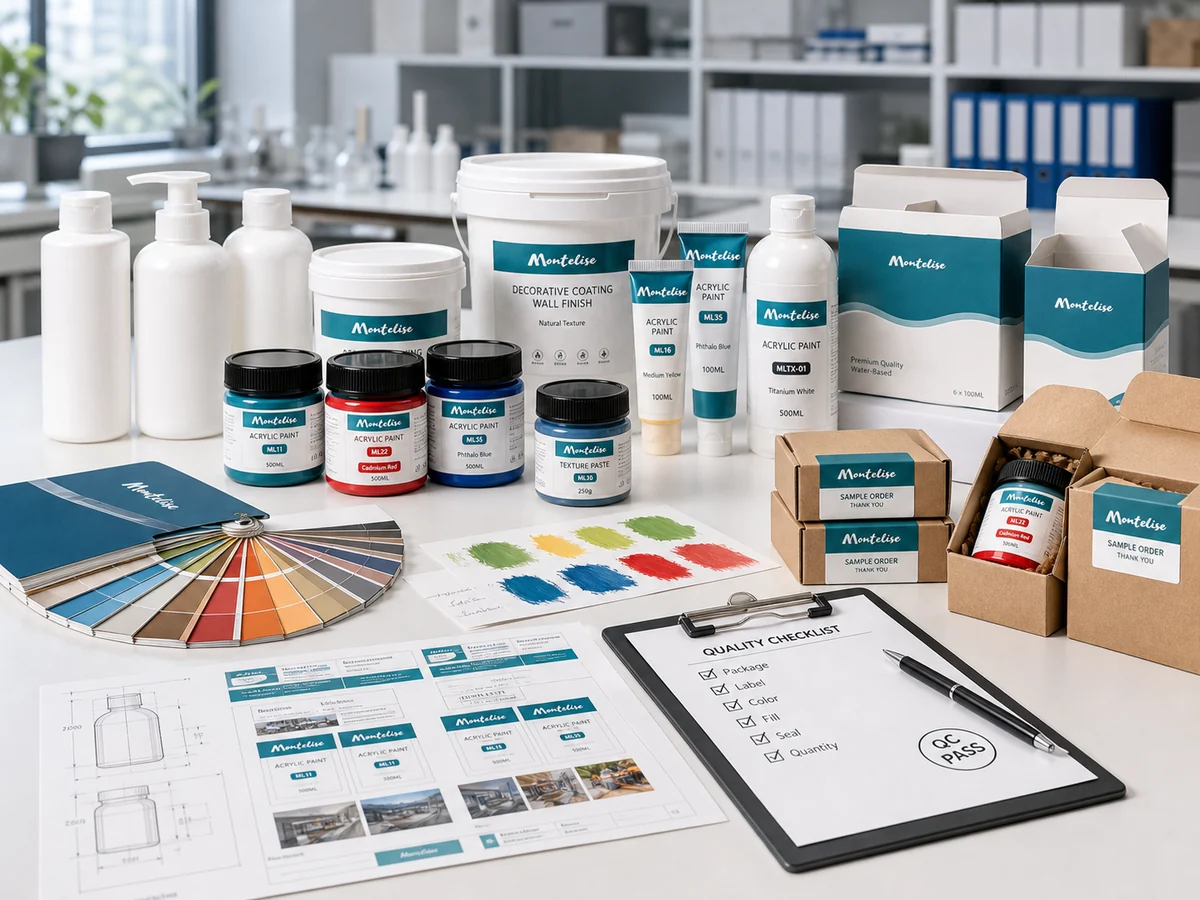
Buyers searching for a private label color material supplier usually are not asking for one loose product sample. They are trying to launch a branded line across paint, textile color, coatings, texture materials, or adjacent categories without splitting the project across several factories. The supplier question is not only “can you make it,” but “can you keep samples, packaging, MOQ, and repeat orders under one workable system?”
That is where many competitor pages stay thin. The live SERP is full of generic private label paint or coatings pages with contact forms and broad capability claims, but they rarely explain how a buyer should group SKUs, approve colors on the right substrate, or prepare label and export files before the first production run. A stronger supplier page should answer those operational questions early.
Buyer quick links
- View Montelise product lines across paint, coating, textile color, water transfer, and texture categories: Product Center
- Compare OEM development and private label service routes: OEM&ODM
- Send your launch list, packaging target, and market details: Contact / Get Quote
- Start with the broader supplier-evaluation page: OEM Color Material Supplier
Decide Whether the Launch Is Single-Category or Mixed-Category
A private label color material supplier should first know whether the buyer is building one branded line or a mixed assortment. A six-color acrylic-paint launch in 250 ml bottles is a very different project from a coordinated range that includes fabric paint, one texture medium, and a decorative coating sample panel line.
That decision changes:
- how the first sample round is grouped
- whether stock packaging can be used for pilot samples
- which MOQ applies by formula, by pack size, or by artwork version
- whether one shipment window is realistic across all categories
- how reorder references should be retained after launch
| Launch Type | What the Buyer Should Lock First | Common Risk if Left Open |
|---|---|---|
| Single-category paint line | core colors, pack size, label format | too many color variants in round one |
| Mixed paint and coating line | lead category and support SKUs | quote becomes too broad to approve |
| Retail private label test | barcode, carton count, shelf pack | artwork work starts before formula approval |
| Distributor bulk line | container sizes, pallet logic, export files | lead time looks short but misses logistics details |
Buyers who are still narrowing categories should review Custom Color Material RFQ before asking the supplier to quote every possible SKU.
Build the First Sample Round Around Pack Families
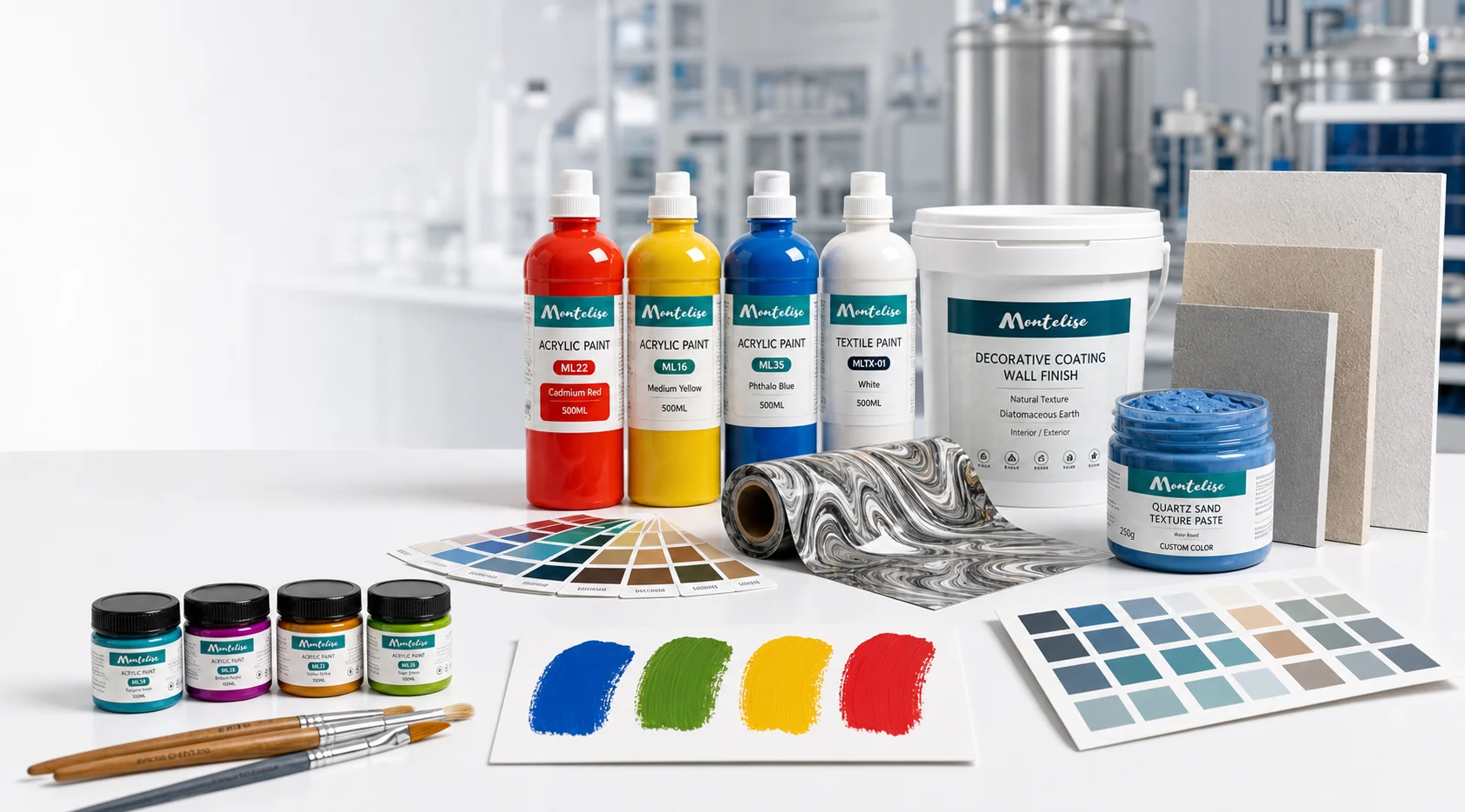
One reliable way to keep a private label project on schedule is to group the first launch around realistic pack families. Competitor pages often say “flexible packaging” without telling buyers how to use that flexibility. In practice, too many container changes in the first round create avoidable delays.
For a cleaner first sample round, buyers should confirm:
- whether the launch uses 60 ml, 120 ml, 250 ml, 500 ml, 1 L, 5 kg, or 20 kg formats
- whether bottles, jars, pails, or sample cups are needed by category
- whether stock containers are acceptable for the first formula review
- whether custom labels wait until the formula is approved
- whether cartons are plain export cartons, branded shelf cartons, or mixed-SKU master cartons
This matters because a private label color material supplier may support several product families, but the first launch still works best when the packaging route is simplified. For example, a retail acrylic line may sample in 250 ml bottles with temporary labels, while a decorative coating item may sample in 1 kg tubs before the buyer commits to custom bucket printing.
Planning a private label color material launch?
Share your lead product family, pack sizes, quantity split, and destination market with Montelise. The team can suggest which packaging items should be fixed before sampling and which ones can wait until after approval.
Approve Colors and Finishes on the Correct Substrate
The biggest gap across ranking competitor pages is how little they say about approval method. A private label supplier should not only ask for a color reference. The supplier should ask how that color or finish will be judged.
Buyers should tell the supplier:
- whether the reference is Pantone, a dried hand sample, a fabric swatch, a wall panel, or a retained production sample
- which substrate will be used for approval, such as canvas, cotton, wall board, plastic, or paper
- how many shades or finishes belong in the first round
- whether one revision round or two comparison rounds are expected
- which approved sample code should become the reorder standard
That level of detail affects both sample timing and repeat control. Fabric paint approved on cotton may not read the same on a coated test card. A decorative coating checked on a small swatch may still need a larger panel before the buyer signs off. Buyers planning a wider multi-category program should also review Color Material MOQ because sample spread and pack spread usually change the commercial minimum together.
Lock Artwork, Carton Marks, and Export Files Before the PO
Many private label projects slow down after sample approval because the commercial file set is still incomplete. A practical private label color material supplier should ask for the non-formula details before the PO is finalized.
The most useful checklist includes:
- label artwork in AI or editable PDF
- barcode type such as UPC, EAN, or internal SKU code
- language version for labels and cartons
- carton marks and shipping-mark format
- export paperwork needed, such as commercial invoice, packing list, SDS, COA, or certificate of origin when required
- pallet instruction, such as mixed-SKU pallet labels, heat-treated pallets, or neutral export pallets
This is where many generic private label paint pages underperform. They promise branding support, but they do not explain which files actually unblock production. Buyers whose next step is pricing rather than sampling can continue with Color Material Bulk Quote after the commercial file list is clear enough.
If the launch includes several product families instead of one private label line, Multi-Category OEM Paint Supplier shows how buyers can group lead categories, support SKUs, and shared export files before the first production slot is booked.
Ask Lead Time by Dependency, Not by One Number
When a supplier says “lead time is 20 to 30 days,” the buyer still needs to know what that number depends on. Private label color-material projects usually move by dependency rather than one universal schedule.
Lead time normally changes with:
- standard base versus custom formula adjustment
- how fast the buyer comments on the first sample round
- whether label and carton artwork is already approved
- whether one factory date must cover several categories
- whether export-document review is needed before shipment
A good supplier answer breaks timing into sample preparation, packaging approval, production booking, and shipment readiness. Buyers comparing more than one supplier should ask each factory to present timing this way. It makes the comparison more useful than broad claims about “fast delivery.”
What to Send for a Faster Quote
What to send for a faster quote
- Lead product family and any support categories in the same launch
- Color, finish, or pattern references plus the approval substrate
- Pack sizes, container types, and whether stock packaging is acceptable for samples
- Estimated quantity per SKU, per category, and total launch plan
- Label artwork status, barcode needs, and carton requirements
- Destination market, required export files, and target launch date
Final Thought
The right private label color material supplier is not the one with the longest product list. It is the one that can organize categories, sample approvals, packaging logic, artwork files, MOQ structure, and reorder references into one controlled launch plan. That is what turns a mixed inquiry into a production-ready private label program.
Montelise supports private label and OEM buyers across acrylic paint, textile paint, decorative coatings, hydro dipping materials, texture paste, and related color-material lines. contact Montelise with your product mix, target pack sizes, estimated quantities, and market requirements to request samples or a bulk quote.
FAQ
What should buyers ask first when screening a private label color material supplier?
They should ask whether the supplier can support the exact launch scope under one approval and packaging system, including samples, MOQ logic, artwork handling, and repeat-order control.
Should buyers sample every category in full private label packaging?
Usually no. Most projects move faster when the first round uses stock packaging or simplified labels until the formula and product direction are approved.
Why does substrate matter for private label color approval?
Because the same color or finish can look different on canvas, cotton, wall board, plastic, or paper. Approval should happen on the surface closest to the real application.
Which files delay private label production most often?
The most common delays come from missing editable label files, unclear barcode requirements, incomplete carton marks, and export-document lists that are added too late.